Showing posts with label Bandanna asterism. Show all posts

Thursday, October 8, 2009

Get Out Your Bandannas

Note: There will be no October 15 post. Enjoy the October 8 post or browse my older posts. I'll be back with a new post on October 22.

Let’s wrap up our exploration of Capricornus the Sea Goat with a telescopic look at one of my favorite deep-sky objects: the globular cluster Messier 30.

Globular clusters, or “globs” as they are called in the astronomy community, are dense balls of gravitationally bound stars. There are at least 150 known globs scattered about our home galaxy, the Milky Way. Globs contain tens of thousands to millions of stars.

A number of the brighter globs that can be spotted from the Northern Hemisphere are found in the Messier catalog (MESS-ee-yay). This is the catalog of 110 deep-sky objects compiled by the famed 18th century French astronomer Charles Messier, who observed from the rooftops of Paris. The Messier catalog contains some of the finest binocular and telescope objects in the night sky and is widely used by amateur astronomers as an observing list.

Globs are my favorite type of deep-sky object, and Messier 30— or M30 as it is commonly known— is one of my favorites because of its irregular shape. I find the globs that are a bit asymmetric, rather than perfectly spherical, to have the most visual appeal.

Use the star map below to locate M30, just to the left (east) of the Bandanna asterism. If you have a dark sky (Moon-free and light pollution-free), try spotting it with binoculars first. If successful, you’ll see a small fuzzy ball, something like the end of a Q-tip.


Messier 30 in Capricornus
Star maps created with
Your Sky


But honestly, M30 is one of those objects that is best examined in a telescope. Depending on your aperture (diameter of the primary optical element)— which dictates your telescope’s ability to collect light from faint celestial objects— you may begin to resolve the cluster. If so, the stars in the cluster will begin to separate into distinct points of light, and you’ll be able to truly appreciate M30’s endearing quirkiness.

Once you’ve located M30 with a low-power eyepiece (high mm number), switch to a high-power eyepiece (low mm number) and pump up the volume. This object warrants the most magnification you can muster.


Globular cluster M30
Source: NASA/ESA


Honk if you love globs. Or just wave your bandanna.


Astronomy Essential: Human eyes can adapt to the dark.

Seasoned night-sky observers typically go through a ritual called dark adaptation prior to embarking on an evening of stargazing. Dark adapting involves avoiding all white-light sources for 20 to 30 minutes, which prepares their eyes for enhanced seeing in the dark.

In a dark environment, first the human eye responds with pupil dilation. Next, chemical changes occur in our retinas’ receptors: the rods and cones. The rods become super-sensitized to light, thereby enabling us to see in low-light conditions.

As you can imagine, dark adapting— and then avoiding bright light once adapted— results in greater success seeing faint celestial objects through binoculars or telescopes, as well as with the naked eye. Astronomers maintain their dark adaptation by using red-light flashlights, since red light does not interfere with night vision.

Thursday, October 1, 2009

The Sea Goat Revisited

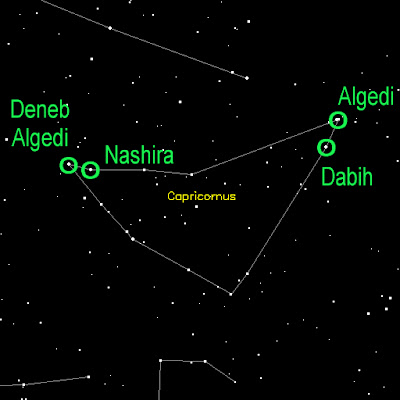
In my previous post I introduced you to Capricornus the Sea Goat and its defining asterism (star pattern), the Bandanna.

This time, let’s take a look at the more prominent stars of the Bandanna— the ones with traditional names. They all lie along the top of the Bandanna. If you need help locating Capricornus, review my previous post.

The top left corner of the Bandanna is marked by Deneb Algedi, from the Arabic for tail of the goat. Deneb Algedi (DENN-ebb uhl-JEDD-ee), the brightest star in Capricornus, is a white star that lies about 39 light years away. A light year is the distance light travels in one Earth year, nearly six trillion miles.


The Bandanna of Capricornus
Star maps created with
Your Sky


Moving right (or west), the next bright star is Nashira (nah-SHEE-rah). Its precise meaning in Arabic is unclear, but it references “luck.” Nashira is also a white star, but it lies nearly 100 light years farther away than Deneb Algedi.

Traveling across the top of the Bandanna toward the upper right corner, we next come to Dabih. Dabih (DAH-bee) is from the Arabic for luck of the slaughterer, a reference to the seasonal sacrifice made by Arabs when Dabih first appeared in the dawn sky before sunrise. Dabih is a binary system, that is, two stars in orbit around one another. The brighter of the pair is an orange giant, and the companion star is a blue-white giant. You should be able to “split” Dabih, that is, separate the two component stars, using binoculars.

The upper right corner of the Bandanna is marked by Algedi, Arabic for goat. Algedi is also two stars, but unlike Dabih, the two components are not gravitationally associated. They simply appear close together by line of sight from Earth. This type of double star is called an optical double. Coincidentally, both components of Algedi are yellow stars, similar in temperature to our Sun.

If you have keen eyesight, you should be able to split Algedi with the naked eye. If this proves difficult, the magnification provided by a pair of binoculars will bring you certain success.


Astronomy Essential: Constellations are three-dimensional.

We experience the night sky as if it’s an upside-down bowl, painted black, with an artistic sprinkle of luminous white dots. In other words, we experience it as a two-dimensional plane.

The connect-the-dot star pictures of the ancients, persisting across the centuries, do nothing to disabuse us of this notion.

We stargazers must, therefore, make a conscious effort to remember that the constellations and asterisms we use to navigate the sky are three-dimensional. Although we perceive a particular star pattern in two dimensions, the stars of that pattern are distributed in three dimensions. Some of the stars are relatively close to us, and some are relatively far from us.

If we could fly out into space and “through” a particular constellation, we would experience this first-hand. Zipping past each star in turn, we would finally see the third dimension— the depth— of space. We would finally understand that constellations and asterisms and any other patterns our brain seeks to make from random star positions are simply the artificial constructs of Earth-bound life forms with active imaginations.

Thursday, September 24, 2009

The Sea Goat

Last night the cats fought over who would sleep under the blankets against human warmth and in the sheepskin-lined cat bed. It was a frantic feline version of musical chairs, and when the music stopped, it was every cat for him-or-herself.

This was my first clue that the first nip of autumn was in the air and that flannel sheet season was nigh. My second clue was the “prime time” prominence of fall constellation Capricornus the Sea Goat, which can be seen approaching the meridian from the east about an hour after sunset, when the sky’s just gotten good and dark. It will soon dislodge Sagittarius the Archer— just leaving the meridian, heading west— from its summertime domination of our view to the south.

Capricornus (kapp-rih-KORN-uss) is one of the twelve constellations of the zodiac. This band of constellations is significant because it straddles the ecliptic, the imaginary line that represents the path the Sun appears to take across the sky, as seen from Earth. Because the Earth, Moon, and planets all lie in roughly the same plane as they orbit the Sun, we see the Moon and the planets stick close to the ecliptic as they cross our sky.

You might say the ecliptic represents the plane of our platter-shaped solar system. But I like to think of it, and the zodiacal constellations that encompass it, as the celestial parade route upon which I’m sure to see a procession of planets float by.

Case in point: there are currently two planets passing through Capricornus, Jupiter and Neptune. Jupiter is easily seen with the naked eye; it’s the blazing “star” in the southeastern sky and the first luminary that pops out at you after sunset. Right now you can use Jupiter to help pinpoint the location of Capricornus, should you be unfamiliar with its star pattern.

Viewing Neptune (not a naked-eye object) requires a star map or software application that shows current planet positions, and large binoculars or a telescope.


Star map created with Your Sky


About an hour after your local sunset time, locate bright Jupiter. Using the map above and the relative position shown for Jupiter, trace out in the sky the star pattern shown. This is the asterism (recognizable star pattern) known as the Bandanna, and it contains the brightest stars in Capricornus.


Capricornus in Johannes Hevelius's 1690 star atlas
Courtesy of
Linda Hall Library of Science, Engineering and Technology


Trust me, you’re far more likely to learn to recognize a stellar bandanna than a sea goat. I like Mesopotamian and Greek mythology— and tales of animal metamorphosis— as much as the next person. But honestly, what sort of perverse storyteller would find it necessary to graft a fish’s tail onto the head and body of a goat? It's so grotesque as to defy understanding, so perhaps we should just wave the white bandanna of surrender.

~ ~ ~ ~ ~

Here in the valley of the Rio Grande, the first nip of autumn means sweet relief from stifling summer heat along with the sweet smell of roasting New Mexican chiles. It also means I’ll be harvesting one of my favorite deep-sky objects from the telescopic depths of Capricornus. More on that later. Right now, I’ve got to air out my cozy flannel sheets and clean my high-power eyepiece.

Sweet.


Astronomy Essential: The four gas giant planets don’t have solid surfaces.

It’s hard to comprehend that no interplanetary traveler of the future will ever step out onto the surface of Jupiter or Saturn— even with the right protective space suit. Those gas giants are, as the name suggests, composed of gasses: primarily the elements hydrogen, helium, methane, ammonia, and oxygen.

On the two gas giants farthest from the Sun, Uranus and Neptune, the normally gaseous elements are believed to take liquid or semi-solid form. Gas-infused slush and frigid “seas” of liquid hydrogen, helium, methane, and ammonia make these two ports of call no less inhospitable than their vaporous neighbors.