Showing posts with label Full Moon. Show all posts

Thursday, December 11, 2008

Biggest Moon, Smallest See

This week, for your observing pleasure, I give you the biggest Moon to moon over and the smallest sea to see.

Just after sunset on Friday, December 12, look east to watch the Full Moon rising. This month, the Full Moon occurs only a few hours after it reaches perigee, which makes it the biggest Moon of the year. Perigee is the point in the Moon’s orbit where it’s closest to Earth. The Moon’s orbit is an oval-shaped ellipse, not a circle. At one narrow end of its elliptical orbit, the Moon is at perigee. At the other end, it’s at apogee, the point in its orbit where it’s farthest from Earth.
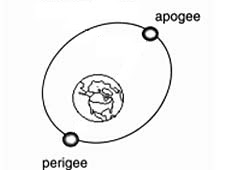


Image source: NASA


As with any object, the closer the Moon is to us, the larger it appears. In particular, Friday’s Full Moon will appear about 14% bigger and 30% brighter than it did when it was near apogee, back in June. Of course, you won’t have the apogee Moon hanging in the sky next to the perigee Moon to aid you in size comparison. You’ll just have to take my word for it and enjoy the show as the super-sized Moon climbs in the sky.


Appearance of Moon at perigee and apogee in 2007


Take advantage of the jumbo Moon to look for the smallest naked-eye lunar feature that most people can see: the Sea of Crises or Mare Crisium (MAH-ray CRISS-ee-yum). A mare (MAH-ray) is a crater that filled with lava that afterwards cooled and solidified into basalt. Although Mare Crisium is not the smallest sea on the Moon, it is a mere 260 miles in diameter. Spotting it is quite an accomplishment.


Image from Wikipedia


Look for Mare Crisium soon after moonrise on the 12th, while the sky is still bright with twilight. I don’t have the sharpest eyesight, and I find it easiest to pick out that feature when the Full Moon is not yet blindingly bright, as it will certainly become after twilight fades and the sky darkens. Mare Crisium will be near the upper limb of the rising Moon; the limb is the outer edge of the Moon’s disc. Look for a small, dark dot just above the “ears” of the Rabbit in the Moon.

If you can’t look on Friday evening, watch for the moonrise on Saturday evening, about an hour after sunset, and try it then. After Saturday, you won’t be able to spot Mare Crisium, as that edge of the waning (shrinking) Moon will be in shadow. You’ll have to wait until a couple days after the next New Moon on December 27 to try to spot the little sea in the first illuminated slice of the waxing (growing) crescent Moon.

If you observe the biggest Moon and/or if you spot Mare Crisium, post a comment on this page and share your success!

Thursday, September 11, 2008

Shine On, Harvest Moon

The Harvest Moon is the Full Moon that occurs nearest the autumnal equinox, also known as the fall equinox. The Harvest Moon usually occurs in September and occasionally in October. This year, the Harvest Moon falls on Monday, September 15, one week prior to the fall equinox on Monday, September 22.

The fall equinox marks our official first day of autumn. Astronomically speaking, the equinox (EE-kwih-nocks) is the moment in time, calculated to the minute, when the center of the Sun is above the Earth’s equator. This occurs only twice a year, in the spring and in the fall.

To understand why equinoxes occur only twice a year, you need to remember that Earth’s axis is tilted 23.5 degrees with respect to its orbit around the Sun. If it weren't, then Earth’s equator would line up with the plane of Earth’s orbit around the Sun, and the center of the Sun would always be above the equator. Of course, we would have no seasons. The temperatures at a given location on the globe would not vary much over the course of a year. We wouldn’t see the Sun arcing high in the sky in the summer or arcing low--nearer the southern horizon--in the winter. It would pretty much follow the same course in the sky, sunrise to sunset, day after day, all year long.


Earth’s tilt with respect to its orbit around the Sun
Image courtesy of Tau’olunga


But that's simply not the case, is it? Our 23.5-degrees-off-kilter planet ensures that here in the Northern Hemisphere we tilt toward the Sun in the summer and experience the heating effect of direct sunlight, and then tilt away from the Sun in the winter and get the chilling effect of indirect sunlight. In spring and fall, midway between the two temperature range (and tilt) extremes, we enjoy moderate temperatures.

Another way to think of the equinox is that it’s when the ecliptic (the imaginary line that represents the path the Sun appears to take across the sky, as seen from Earth) intersects with the celestial equator (the imaginary line that represents the plane of the Earth’s equator, extended out into space). The diagram below shows the twice-yearly intersection of these two lines at the equinoxes.


A Tale of Two Planes: Ecliptic and Celestial Equator
Diagram by
Dr. Guy Worthey


The Earth’s sunward tilt in the summer puts the plane of the equator below the Sun’s center (which corresponds to the ecliptic), and the Earth’s sun-shunning tilt in the winter puts the plane of the equator above the Sun's center. Only during the in-between seasons of Earth’s orbit--spring and fall--can the Sun’s center intersect with the celestial equator and therefore be directly above the Earth’s equator.

The Harvest Moon was so named because it occurs during the traditional peak of crop harvesting in the Northern Hemisphere. In times past, farmers rushing to bring in their crops could continue working by moonlight after the sun had set.

The Harvest Moon was particularly revered by hard-working farmers of old for a reason that has astronomy at its root. Normally, the Moon rises around 50 minutes later each successive night. However, for several days around Harvest Moon, the Moon rises only 25 to 30 minutes later than the evening before. This eliminates or shortens the period of darkness between sunset and moonrise that might otherwise hamper farmers still out standing in their fields. These quicker-than-usual moonrises are so noticeable they’ve given rise to a mistaken but persistent belief that the Moon rises at the same time on successive evenings around the Harvest Moon.

The astronomical reason for the shortened time between moonrises around Harvest Moon is that the angle between the ecliptic and the horizon is very narrow in September. Contrast this with the beginning of spring--in March--when the angle is very steep. The Moon appears to follow approximately the same path across the sky as the Sun, that is, the ecliptic. As the Moon moves along the ecliptic from night to night in September, its shallow angle relative to the horizon ensures that the turning Earth will reach the Moon’s new position on the ecliptic sooner than it would if the ecliptic were steeply oriented to our horizon.

A picture is worth a thousand words, so take a look at this diagram by Patrick Moore, comparing the ecliptic’s angle relative to the horizon in both spring and fall.

The old Anglo-Saxon word for autumn, “hoerfest,” gave us our mouth-watering word “harvest.” Thoughts of the harvest naturally turn to thoughts of food and drink. The Chinese Mid-Autumn Festival, a harvest celebration which occurs near the autumnal equinox, falls this year on Sunday, September 14. The festival includes the ritual eating of mooncakes, round pastries traditionally filled with lotus seed paste and sometimes a salted egg yolk to symbolize the Full Moon. If you don’t have an Asian market offering mooncakes in your area, try this modern recipe for mooncakes.

If mooncakes aren’t your cup of tea, you can always fall back on an American classic: the MoonPie. Developed in 1917 as a snack for coal miners, it was purposely fashioned to look like the Full Moon (and therefore, substantial). The marshmallow and graham cracker treat is available with a chocolate, vanilla, or banana-flavored coating.

For a walk on the wild side, try this Harvest Moon cocktail. As for me, I’ll be toasting in the Harvest Moon with a tall glass of ice-cold apple cider.

Thursday, August 14, 2008

Moon Tunes

This week, I offer you seven days of song, in celebration of the Full Moon that falls on Saturday, August 16. Here’s a septet of my favorite tunes with “moon” in the title.


7) Moonshadow, performed and written by Cat Stevens

The artist formerly known as Cat Stevens wrote this pop hit--considered by many to be an anthem to optimism--while dancing alone in the moonlight on the Spanish seacoast. The song appeared on his 1971 album Teaser and the Firecat.


6) Fly Me to the Moon, performed by Frank Sinatra, written by Bart Howard

The boy from Hoboken practically invented cool, and he swings on this tune from his 1964 album It Might As Well Be Swing. Sinatra’s cover of the 1954 song, already recorded by Johnny Mathis and others, featured a Quincy Jones arrangement and accompaniment by Count Basie and his orchestra. When astronaut Eugene Cernan and a friend made a cassette recording of various popular tunes for Cernan to take into space on the Apollo X mission, they included Sinatra’s version.


5) Moonglow, performed by Benny Goodman, written by Hudson/Mills/DeLange

The only instrumental on my list is from the King of Swing, clarinet virtuoso Benny Goodman. An important figure in 20th century American music, he ushered in the era of swing in the 1930s and played the first jazz concert performed at Carnegie Hall. He was awarded a posthumous Grammy for “Moonglow” in 1998. Goodman’s clarinet will make you sway like a charmed snake, and Lionel Hampton’s killer vibraphone will make you hum like a tuning fork.


4) Blue Moon of Kentucky, performed by Patsy Cline, written by Bill Monroe

The immortal Patsy rollicks her way through this country music standard from bluegrass great Bill Monroe. Recorded in 1963, the year of her untimely death, it was released posthumously the following year on the album A Portrait of Patsy Cline.


3) Moondance, performed and written by Van Morrison

This warm, romantic fusion of rock and jazz is from the 1970 masterpiece album of the same name. With it, Irish bard and consummate musician Van Morrison secured his place in the pantheon of popular music.


2) Bad Moon Rising, performed by Creedence Clearwater Revival, written by John Fogerty

From the 1969 album Green River, this is simple, earthy, hard-driving swamp rock from a great American band. John Fogerty’s voice had me at hello.


1) Moon River, performed by Andy Williams, written by Henry Mancini/Johnny Mercer

Call me sentimental, but I can’t resist this sweet ballad and its evocation of my childhood. Famously sung by the reedy-voiced Audrey Hepburn in the classic film Breakfast at Tiffany’s, it won the Academy Award for Best Original Song of 1961. Andy Williams performed it at the Oscars ceremony and made the song his own. Although it’s been covered by countless artists, I remain partial to Williams’s honeyed baritone and flawless phrasing.


What’s your favorite moon-titled song? Add your comment below, and keep on shining.

Thursday, July 17, 2008

Moon in the Balance

I am torn.

As an amateur astronomer, I must arrange my observing life around avoidance of the Moon; wait impatiently for it to set; nervously watch the eastern horizon for its arrival; hide from it behind trees, rock outcroppings, vehicles, and outhouses; wail and curse it when it appears. Let’s face it, that old incandescent Moon is the bane of every hunter of "faint fuzzies": deep-sky objects pursued with telescopes, binoculars, and much lurching about in pitch-dark places.

Faint Fuzzies: Hickson 44 galaxy group


As a human being, though, I must marvel at the Moon and think how lucky we are. We have a natural satellite that shows us, through its phases, that it revolves around us. When it covers the Sun during a solar eclipse or moves into the Earth’s shadow during a lunar eclipse, we have a glimpse into the clockwork of the universe. We have a naked-eye view of the surface of another solar system body. We even have a cosmic timepiece that ticks along reliably enough to give us the basis for our system of calendar months. (Did you know the word month is derived from the Old English word for moon, mona?)


The approach of Full Moon on Friday the 18th has me pondering what I’d do if given the power to choose between keeping the Moon or banishing it forever. A giddy free-for-all of deep-sky diving, unfettered by the lunar cycle, versus a glowing orb that has inspired humans throughout history to pen poems, create art, write songs, do science, and pitch woo. The everlasting happiness and gratitude of my stargazing brethren versus the artistic, scientific, and romantic outpourings of the human race. It would be a tough call.

There are some practical reasons to keep the Moon. In a previous post, I discussed precession, the slight wobble of Earth’s axis. This wobble is caused by gravitational tugging by both the Sun and the Moon. If the Moon were removed from the picture, Earth’s wobble would destabilize, becoming more erratic and pronounced. This would most likely result in dramatic climate changes.


Image courtesy of PDPhoto.org

Another reason to hang on to our satellite has to do with tides. The combined gravitational pull of Sun and Moon causes the cyclical rise and fall of Earth’s oceans, the tides. Although the removal of just the Moon would not eliminate the tides, it would certainly disrupt them. The feeding and breeding activities of various marine and shore creatures could be severely impacted.

Even if we subtract these practical considerations from the equation, ultimately I think I’d miss the Moon if it were gone. I’d miss how the waxing crescent looks like a big, happy tangerine slice before it sets, and a crescent in the clouds like a shark fin slicing through seafoam. I’d miss that loopy Moon illusion that makes the rising Full Moon look unnaturally big. I’d recall the lunar eclipses I’ve watched and how the Moon in Earth’s shadow always turned red--sometimes russet, sometimes scarlet. I’d miss the gasps and whoops that a telescopic view of the Moon’s crater-pocked surface elicits at public astronomy events. I’d miss my own telescopic tramps across the Moon and moments of discovery. Strangely, I think I’d even miss the collective groan that rumbles across a star party’s observing field when the Moon bobs up in the east.

Observing field at a star party


So, at the end of the day, with all that fateful power at my fingertips, I’d have to give La Luna the thumbs-up. Of course, I’d also have to change my name, move out of state, and never show my face at another star party. Anywhere. Perhaps we should keep this just between us.

Thursday, May 15, 2008

Top Ten Moon Myths - Part 2

Last month, I gave you my picks for Numbers 10 through 6 of the top ten moon myths of all time. This week, to celebrate the Full Moon on Monday (Moon Day), May 19, let’s finish up the list with my selections for Numbers 5 through 1.

5) Plant growth is influenced by moon phases. The practice of lunar gardening or lunar agriculture--planting and harvesting according to moon phases--is ancient. Many cultures around the world have subscribed to it, and it’s a mainstay of folkloric tradition. A surprising number of modern folks practice it too; references can even be found in modern farmer’s almanacs.

The practice hinges on the belief that the Moon’s gravitational force exerts an influence on the flow of moisture in soil and plants. Lunar gardeners believe, for example, that crops producing their yield above ground should be planted during the waxing (growing) moon. The time to plant root crops is during the waning (shrinking) moon. However, no planting should be done on the New Moon or Full Moon--or, strangely, on any Sunday.

There is no body of scientific data that supports the claims of the lunar gardeners. At some point in prehistory, the use of the lunar calendar as a planting calendar--a simple tool to ensure crops went in at the right time--may have evolved into a belief system linking the Moon to agricultural success. And we humans do cling tenaciously to our belief systems, don’t we?

4) The Apollo moon landings were a hoax. Let’s see: the testimony of the astronauts who went there, the hundreds of pounds of unique moon rocks that have been examined by scientists around the world (as well as displayed in museums), the voluminous number of archived mission photographs, in other words, overwhelming evidence to the contrary. Most of the ‘hoax evidence’ claims are skillfully debunked here.

And that's all I have to say about that.


Image source: NASA


3) There is a link between the Full Moon and an increase in mentally disturbed behavior, criminal activity, women going into labor, etc. Notwithstanding that the word lunatic comes from the Latin word for moon, numerous studies have found no definitive link between mental hospital admissions and the Full Moon. There have been many studies conducted on the possible link between the Full Moon and crime, with no clear pattern emerging. Some have postulated that the Full Moon may simply create the optimum lighting condition for nighttime mischief-making, rather than influence behavior. Finally, no link supported by scientific studies has been found between the Full Moon (or any moon phase) and birthrates.
Anecdotal evidence is plentiful and proliferative, but perception is most assuredly not the same thing as objective analysis of reliable data (what we like to call “science”).

2) We can see the American flag on the Moon’s surface from Earth. I hear it all the time at star parties when the Moon is out: “Show me the flag on the Moon!” Some folks actually get incensed when I explain to them that I can’t: “But you just showed me a galaxy millions of light years away. Why can’t you show me the flag?!”

I’m sure the conspiracy theorists would say: “Aha. We can’t see it because it was never there.” But the truth is the smallest feature we can see on the Moon--using even the orbiting Hubble Space Telescope--is about 300 feet across. We would need an immensely large telescope to possess the light-gathering capability that is needed to see such a small, dim object like a flag--one that doesn’t produce light, but only reflects it. A galaxy, on the other hand, although tremendously more distant, is gargantuan compared to a flag. In addition, it emits the collective light of several hundred billion stars.

And the number one moon myth of all time:

1) The Moon is made of green cheese. One of the earliest references to a cheesy moon has been attributed to the 16th century French satirist Francois Rabelais: “Thought the moon was made of green cheese.” Green, in his time, meant new, non-aged cheese, and--clever writer that he was--he cast the Moon's dark maria or seas (basalt-filled craters) as the bubbles in a wheel of cheese. In a different time and place, however, the green was misinterpreted as the color, and so began the charming--albeit silly--practice of befuddling small children by telling them the moon is made of green (sounds pretty yucky) cheese.

The 17th century clergyman John Wilkins wrote: “You may as soon persuade some country peasants that the Moon is made of green cheese…as that 'tis bigger than his cart wheel.” Apparently, 17th century country bumpkins were not to be hoaxed by tales of lunar edibleness, even if they couldn't be convinced of lunar immenseness.


Image source: NASA

Thursday, April 17, 2008

Top Ten Moon Myths

As you gaze at this week’s big moon--and frolic in the light of the Full Moon on Sunday, April 20--ponder my picks for Numbers 10 through 6 of the top ten moon myths of all time:

10) The Moon’s surface is completely smooth. Early science through the time of the Renaissance was based upon the teachings of the influential Greek philosopher Aristotle. According to his worldview, the Moon was a perfect sphere with a perfectly smooth surface. The invention of the telescope in the 17th century blasted that myth into oblivion. When the pioneering Italian astronomer Galileo turned his homemade telescope skyward in 1609, he discovered that the Moon was pockmarked with craters and crisscrossed with mountains and ridges.

Unfortunately, Galileo misinterpreted one type of lunar feature he saw: the dark, basalt-filled craters. He thought they were water features similar to Earth’s seas. Consequently, lunar mapmakers of the time gave them names beginning with “mare,” the Latin word for sea, and those names persist to this day.


9) The Moon does not rotate. Many think that, because the same side of the Moon always faces the Earth, it doesn't spin. In fact, if it did not rotate on its axis, we'd eventually see all parts of the Moon parade by us over the course of its month-long orbit around Earth. But we don’t, do we?

Millions of years ago, the strong pull of Earth’s gravity put the brakes on the Moon’s spin, slowing it down until its rotation became synchronous with its orbital motion. Now the Moon makes one complete rotation on its axis in the same time it takes to complete one orbit around the Earth. You can picture this slow rotation best if you imagine observing the Earth/Moon system from the Sun. From your vantage point on the Sun, you could watch Moon circling Earth, turning just enough on its axis to keep the same face toward Earth as it went around. And from the Sun you’d notice that, over the course of a month, your view of the Moon’s surface continually changed until you'd seen it all, proving that it was rotating.

8) Dogs and wolves howl at the moon. This is a common belief--perpetuated in popular art, music, and film--but there's no scientific evidence that it is so. Dogs and wolves howl to communicate with one another. A couple theories as to why humans have imagined this causal relationship between the Moon and howling animals are: a) Animals, particularly predators, may be more active on moonlit nights when they can see better, and b) When we hear animals howl at night, we're more likely to notice a big moon in the sky if it’s plainly visible. However, we may not recall all the times we heard animals howl when there was a crescent moon or no moon in the sky. This is called selective memory, and we use it to perpetuate our already-held beliefs.

7) The Full Moon is larger when it’s near the horizon than when it’s overhead. This effect, known as the Moon illusion, has been recognized since antiquity. How many times have you seen the rising Full Moon hanging just above the eastern horizon and thought to yourself, “The Moon looks huge!”? In fact, the Moon is a little nearer to us and therefore slightly larger in apparent size when it’s high in the sky. Think about it: as the Earth spins east, we are brought toward the Moon.

So what causes us to believe otherwise? The second century mathematician and astronomer Ptolemy first postulated that foreground objects near the horizon, such as trees and buildings, give us something with which to compare the low Moon, making it seem larger. Modern scientific researchers call these distance cues. They are still considered in current theories about the Moon illusion, along with the physiology of our eye muscles and the neurological processes in our brains. Some believe evolutionary selections were made for useful human survival skills like seeing eye-level objects better than high-in-the-sky objects. This skill might improve the chances of finding shelter and food, as well as detecting danger. But there is still no one definitive answer as to why we experience this optical illusion.

6) The Moon has a “dark side.” The Moon has no side that is always dark. The entire surface of the Moon is illuminated by the Sun at one time or another during its month-long orbit around the Earth. However, only half of the Moon’s sphere can be illuminated by the Sun at any given time (shine a flashlight at a baseball, and you'll get the idea).

Although the Moon has no dark side, it does have a far side that always faces away from Earth. Because the Moon’s rotation (spin around its axis) is in lockstep with its revolution (orbit around the Earth), the same lunar hemisphere always faces us.


Stay tuned for next month’s Full Moon to find out which moon myths made my top ten list in the Numbers 5 through 1 slots. Until then, happy howling!