Showing posts with label Hubble Space Telescope. Show all posts

Thursday, October 29, 2009

The Water Jar

Between the Great Square of Pegasus and the Bandanna of Capricornus lies the rather nondescript constellation of Aquarius the Water Bearer.

Aquarius was traditionally depicted as a man upending an urn and pouring water into the mouth of a fish. A bizarre, inscrutable image, perhaps, but nevertheless, the way the ancients imagined it.

Saving the Aquarius constellation from obscurity are two bright stars and a little asterism (recognizable star pattern). Let’s see if we can spot them.
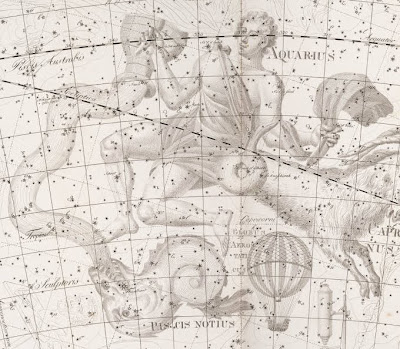

Aquarius in Johann Bode’s 1801 star atlas
Courtesy of
Linda Hall Library of Science, Engineering and Technology


1) About an hour after your local sunset time, face south. If you don’t know the cardinal directions at your location and you don’t have a compass, make note of where the sun sets on the horizon. That spot is approximately west. Stand with your right shoulder to the west, and you’ll be facing approximately south.
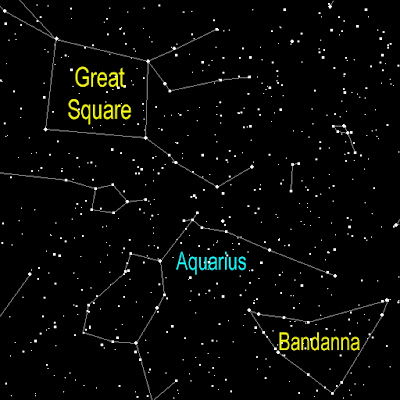

Looking south to Aquarius the Water Bearer
Star maps created with
Your Sky


2) First, locate the Great Square asterism in Pegasus, high in the sky, just east of the meridian, and the Bandanna asterism of Capricornus, low in the sky, just west of the meridian.
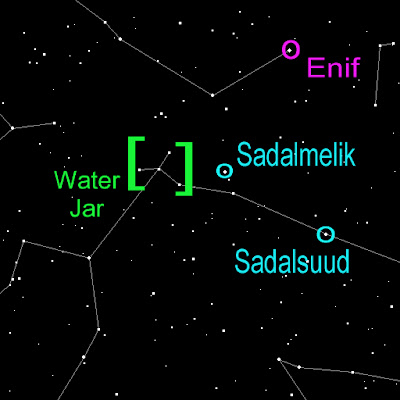


3) Now look between the Great Square and the Bandanna for two bright stars, Sadalsuud and Sadalmelik. Sadalsuud (sah-dull-suh-OOD), from the Arabic for the luckiest of all, is the brightest star in Aquarius. Sadalmelik (sah-dull-MELL-ick), from the Arabic for the luck of the king, is the number two Aquarian. Both stars are yellow supergiants, which is a relatively rare star type.

Don’t confuse them with nearby Enif, the nose of the winged horse Pegusus. Enif is a little brighter than the best and brightest of Aquarius.

4) Just east of Sadalmelik is a little “Y” of four fainter stars. This is the Water Jar asterism, which marks the position of the upended urn in the ancient star picture. If you can’t spot all four, you’ll need to try again at a darker site.
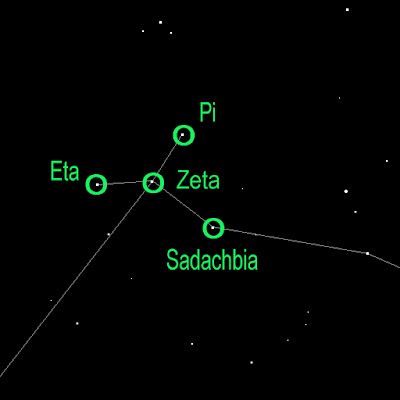

The Water Jar asterism of Aquarius


Of the four stars, only one has a traditional name: Sadachbia. Sadachbia (sah-DUCK-bee-yah), from the Arabic for luck of the tents, is a white star. We call the other three stars Eta, Zeta, and Pi, for their star catalog designations. Zeta, in the center, is the brightest star in the asterism.

Although Sadachbia is not the brightest of the Water Jar quartet, it clearly had enough significance to the ancients to be named and to be considered lucky like Sadalsuud and Sadalmelik. Perhaps whenever the early Arabs thanked their lucky stars, they had Aquarius in mind.


Astronomy Essential: We don’t see celestial objects the way cameras do.

Beginning stargazers are sometimes disappointed by their first telescopic view of a deep-sky object such as a galaxy, nebula, or star cluster. They expect the technicolor, high-resolution panoramas seen in Hubble Space Telescope images, which have become part of our public consciousness.

Instead they get small, fuzzy, black-and-white blobs.

What technology-savvy newcomers don’t realize is that human eyes are limited instruments. Collecting and integrating the faint light from distant objects— light that has traveled many trillions of miles to reach us— pushes our eyes to the limits of their ability. And in low-light situations, we don’t see color well. Compare that to the ability of an ultra-sensitive camera chip to detect extraordinarily faint light and integrate it over a long exposure time. Add to that the ability of specialized image-processing computer software to “stack” multiple images of an object, as well as color-correct the composite to approximate the color signatures of the chemical elements found in each celestial object.

What we can’t accomplish at the telescope eyepiece, we can accomplish at the computer keyboard.

At the end of the day, however, there is no substitute for looking at an astronomical object with your own eyes, collecting on your retinas those faint photons of light that have traveled many years to reach you, and discerning an image of a far-away world in real time, live, under your own power.

Thursday, October 9, 2008

It's a Bird!

The days of the month surrounding Full Moon can sometimes feel like an astronomical “dead zone.” The floodlight effect of our lunar neighbor on the night sky makes everything from tracing out naked-eye star patterns to telescopic viewing of deep-sky objects difficult to impossible.

Certainly you can enjoy looking at the Moon itself. There are interesting craters to behold with your binoculars or telescope. Naked-eye moongazers with an extra dollop of imagination can look for pareidolia among the Moon’s dark maria or “seas.”

But here’s another diversion for those suffering from Full Moon fever: satellite watching. Many satellites are naked-eye targets, they’re generally bright enough to be seen on moonlit nights, and they travel in predictable orbits. What could be easier?


Image source: NASA


Satellites, colloquially known as “birds,” are man-made objects in orbit around Earth. Typically, they are unmanned communications, navigation, and observation stations. One notable unmanned craft is the Hubble Space Telescope, which regularly returns remarkable, detailed images of celestial objects, for scientific study and public enjoyment.

Some satellites are simply large pieces of space junk. These may include stations that are no longer operational but which continue to circle the planet until their orbits deteriorate, they enter Earth’s atmosphere, and they vaporize before impact (hopefully). Space junk may also include objects that have been jettisoned from manned craft.

Which brings us to the manned station circling the planet: the International Space Station (ISS). The ISS is a 16-country international collaboration: proof positive that human beings can work together for the advancement of the entire human race. This engineering marvel, with a resident multi-national crew on board, completes an Earth orbit every 90 minutes.


International Space Station
Image source: NASA


By the way, the word “satellite” is also used in astronomy as a synonym for “moon,” as in, “Saturn has 34 satellites.” The Moon is sometimes referred to as a natural satellite of Earth.


Image source: NASA


There are two terrific websites that can help you get started with man-made satellite watching. The first one I’ll mention, because it’s the easiest for beginners to use, is Satellite Tracker by spaceweather.com. Simply enter your zip code on the home page, click the “Go” button, and you’ll get a list of the best-and-brightest satellite flybys in your area over the next ten days. For each flyby, the rise time (when the satellite first appears over the horizon) and the transit time (when the satellite is at its highest in the sky) are both given in your local time. Nope, you won’t have to do any pesky conversions.

You’ll also be given the compass direction in which to look, as well as the predicted magnitude (brightness) of the satellite. You may recall from my previous discussion of the star Vega that objects with negative-number magnitudes are brighter than objects with positive-number magnitudes. However, you don’t need to remember that to use this website; the magnitude is also characterized for you as “very bright,” “visible,” or “dim.” Start with the satellites labeled “very bright,” as you’ll have the best chance of success with these. Once you have a few bright flybys under your belt, work your way up to the “visible” and “dim” objects.

Keep in mind that you’ll only see low-flying satellites such as the ISS (~250 miles above Earth) and the Hubble Space Telescope (~350 miles above Earth) shortly after sunset or shortly before sunrise. Satellites are visible to us only when they’re reflecting sunlight. A low-orbit satellite passing overhead in the dead of night would be in Earth’s shadow, with the Sun on the other side of the planet and no way to receive light from it.


Hubble Space Telescope
Image source: NASA


How can we tell a satellite from a plane? A satellite moves in a straight line and is usually visible for only a few minutes before winking out. A plane will typically be visible for longer, and you may see directional change. Also, a plane will usually have flashing lights and/or colored lights. If it’s close enough and the observing environment quiet enough, you’ll hear the plane’s engine(s). Satellites are silent. Several lights moving in formation are often military craft performing maneuvers.

The second website I’d like to recommend, for intermediate and advanced observers, is Heavens Above. On the home page, select your current observing site “from database” by selecting your country and typing in your town name. When it appears on the search results, click your town name to select it as your location. Then in the “Satellites” section, request your desired satellite predictions. This site also gives you pass results in local time, but it’s expressed in military time. I don’t know about you, but I don’t think in military time. Points taken off for making me do a pesky conversion!

Heavens Above gives prediction data for many more satellites than the Satellite Tracker site, and you can also request data for a specific satellite from their large database. Plus, the website offers much more than just satellite data. The “Astronomy” section has current data about visible comets and asteroids, and lots more.


On the evening of October 8, I took a last gulp of ice tea and hurried out of my local diner with four minutes to spare before a scheduled ISS pass. Soon, my partner, two other customers, a waitress, and a cook joined me in the parking lot to scan the northwestern horizon for the first appearance of the Space Station. Satellite spotting is a great activity to share with adults and kids, friends and perfect strangers.

We had a few false alarms as planes appeared over the horizon, heading for the international airport nearby. One of the customers was the first to whoop, “There it is!” Then we all spotted it, a steadily moving light already well above the horizon. The cook scurried back inside to flip some burgers and answer the phone, while the rest of us watched it climb and waved to the unseen crew inside.

Shortly after it reached the highest point of the pass, the reflected sunlight from the satellite became ruddy-colored. It was sunset on the ISS. From the astronauts’ vantage point as they rounded Earth, the Sun was sinking below Earth’s horizon. Then the satellite was swallowed by Earth’s shadow, and the light winked out.

Just think: if you were a sleepless astronaut on the ISS, over the course of 24 hours you could watch the Sun rise and set many times. Busy old fool, the poet called him.

…since thy duties be
To warm the world, that’s done in warming us.
Shine here to us, and thou art everywhere;
This bed thy center is, these walls thy sphere.
from The Sun Rising, by John Donne