But if I were to allow myself a brief indulgence in the alternate reality espoused by DeBeers and Tiffany’s, I would set my sights a little higher. Give me the Diamond of Virgo.
The Diamond of Virgo is a wonderful four-star, spring-into-summer asterism that, when spotted, reveals the location of four constellations. Please step into my showroom.
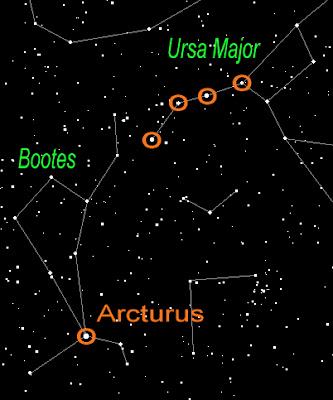
1) About an hour after sunset, face the western horizon, that is, toward the direction in which the sun set earlier.
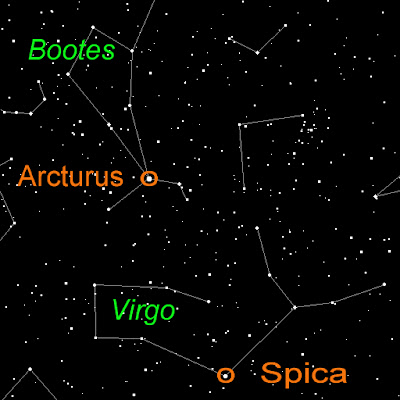
 Star maps created with Your Sky
2) Look high in the sky, a little towards the north, for the large, distinctive seven-star asterism (star pattern) known as the Big Dipper. In its current orientation, its handle will be sticking up above its bowl. Extend the curve of the handle in an imaginary line away from the bowl, until you reach a very bright star. This is Arcturus, the first point of our stellar diamond. Arcturus (ark-TOUR-uss) is an orange giant star, the brightest star in the constellation Bootes (boh-OH-teez) the Herdsman, and the fourth brightest star in the sky.
 The Diamond of Virgo asterism
3) Now continue that same imaginary curving line toward the southwestern horizon until you reach the next bright star: Spica, brightest star in the constellation Virgo the Maiden and the second point of our diamond. Spica (SPY-kuh) is a blue-white dwarf star, and not as bright as Arcturus. Take a moment to compare Spica to Arcturus in order to see the subtle color difference. Can you discern the orange or golden color of Arcturus now, as compared to the blue to blue-white light streaming from Spica?
4) Below Arcturus and Spica, that is, closer to the western horizon, look for the shape of the constellation Leo the Lion. Our fearless feline dives after the setting sun. His head is marked by the Sickle asterism, which looks like a backwards question mark. His tail, higher in the sky than the head, is marked by a right-triangle asterism. The star in the right triangle that is highest above the western horizon is Denebola, the third star in our celestial gemstone. Denebola (denn-EBB-oh-luh) is a white dwarf star, and it’s dimmer than either Arcturus or Spica.
5) Mining our sky diamond has been fairly easy up to now. The fourth and final star is the most challenging, because it’s dimmer than the other three.
Our quarry is Cor Caroli (core CARE-oh-lye), brightest star in the constellation Canes Venatici (KAY-neez vee-NATT-uh-sigh). It lies to the right (or north) of the other three diamond points, and it lies between Spica and the handle of the Big Dipper, closer to the handle. To aid in finding it, draw an imaginary line between Denebola and the star at the end of the Big Dipper’s handle. That line will cross the white dwarf star Cor Caroli, which is a bit dimmer than Denebola.
If you can’t spot it, you may need to try again at a darker location, as an absence of light pollution is a big plus when hunting dimmer stars.
Cor Caroli is Latin for Heart of Charles and commemorates Charles II, King of England from 1630 to 1685. It was astronomer Edmond Halley (of Halley’s Comet fame) who honored the king—40 years after his death—with this designation, although it may have been Charles’s court physician who first suggested the heavenly namesake.